
On many developments today, the biggest risk to programme and budget isn’t the building itself. It’s whether the utility networks can serve it.
Limited grid capacity, long connection lead times and unexpected connection costs are now common, and they often come to light only once the design is well advanced and the options are more limited.
Petrie Buchanan, an independent utility consultancy advising on gas, water, electricity, renewables and telecoms, joined the Wallace Whittle Group earlier this year. Working alongside our MEP and sustainability teams, Petrie Buchanan gives our clients utility advice from the earliest stages of a project, so infrastructure constraints can be understood and planned for before key decisions are made.
Why utilities and building services need to work together
Utility consultants look at how buildings connect to external networks via new utility infrastructure. MEP engineers design how those services are distributed and used within the building. The two are closely linked, but on many projects they’re handled separately, and a decision in one area can quickly affect the other.
That gap matters more as buildings move towards electrification. Heat pumps, electric hot water and EV charging are pushing electrical demand up sharply, and available network capacity can now shape a building’s whole energy strategy.
“The drive towards net zero and building electrification is significantly increasing electrical demand within developments. The move away from gas-fired heating towards heat pumps, electric hot water generation, electric vehicle charging and all-electric developments means that utility infrastructure and building design are now much more closely linked than they have been historically.
Utility capacity is increasingly becoming a key design constraint, requiring earlier engagement with network providers and utility specialists to ensure that low-carbon design ambitions can be delivered.”
Felipe Tibabuzo Castro, Associate Director Sustainability, Wallace Whittle

What this means for you
- Utility, MEP and sustainability advice from one coordinated team
- Earlier identification of risks to cost, programme and capacity
- Infrastructure planned for every phase of a development, not just the first
- Design decisions based on what the network can deliver
- Access to a wider pool of expertise across our offices throughout the UK
Our colleagues at Petrie Buchanan understand network capacity and connection requirements, so our design teams can work with realistic limits from the outset. Our load assessments and energy modelling can give Petrie Buchanan accurate demand figures to take to network operators. You can then apply for the capacity your building actually needs, without paying for more than you’ll use or finding later that it isn’t enough.
“Bringing utility, MEP and sustainability expertise together at the earliest project stages allows capacity constraints, energy demands and carbon reduction opportunities to be considered holistically. This can help inform site selection, master planning, energy strategy development and infrastructure requirements before key project decisions are fixed.”
Felipe Tibabuzo Castro, Associate Director Sustainability, Wallace Whittle
Where this makes a big difference
District heating is becoming an essential utility in its own right, and central to decarbonising heat in towns and cities. With heat network zoning being introduced in Scotland and England, more developments will be expected to connect to a heat network, or be designed so they can in future.
A successful network depends on proper infrastructure masterplanning from the outset. Large heat pumps and energy centres need significant electrical capacity, which can affect development proposals. It’s also important to make use of as many heat sources as possible, from industrial waste heat and geothermal to heat from data centres. The heat mains then have to be routed through streets and sites already crowded with gas, water, electricity and telecoms services, so an early understanding of existing networks is essential.
Inside the building, the MEP design must work with the network. Heat networks run most efficiently at low return temperatures, so heating and hot water systems, heat interface units and plant rooms all need to be designed to suit. When building design and network design are considered separately, the result can be poor performance, higher running costs, and a missed carbon opportunity.
Data centres are a good example of where this is heading. They generate large amounts of waste heat that would otherwise be rejected to atmosphere, and that heat can be captured and supplied to nearby homes, businesses, and public buildings through a heat network. But recovering heat at scale means bringing together the data centre’s cooling design, the electricity and water it depends on, and the infrastructure to carry that heat to where it’s needed.
Our combined expertise covers that whole picture. Petrie Buchanan understands the networks, capacity and connections; we bring the MEP design and sustainability expertise. Together we can help you assess heat sources, plan energy centres and connections, and design buildings that get the most from a low-carbon heat network.
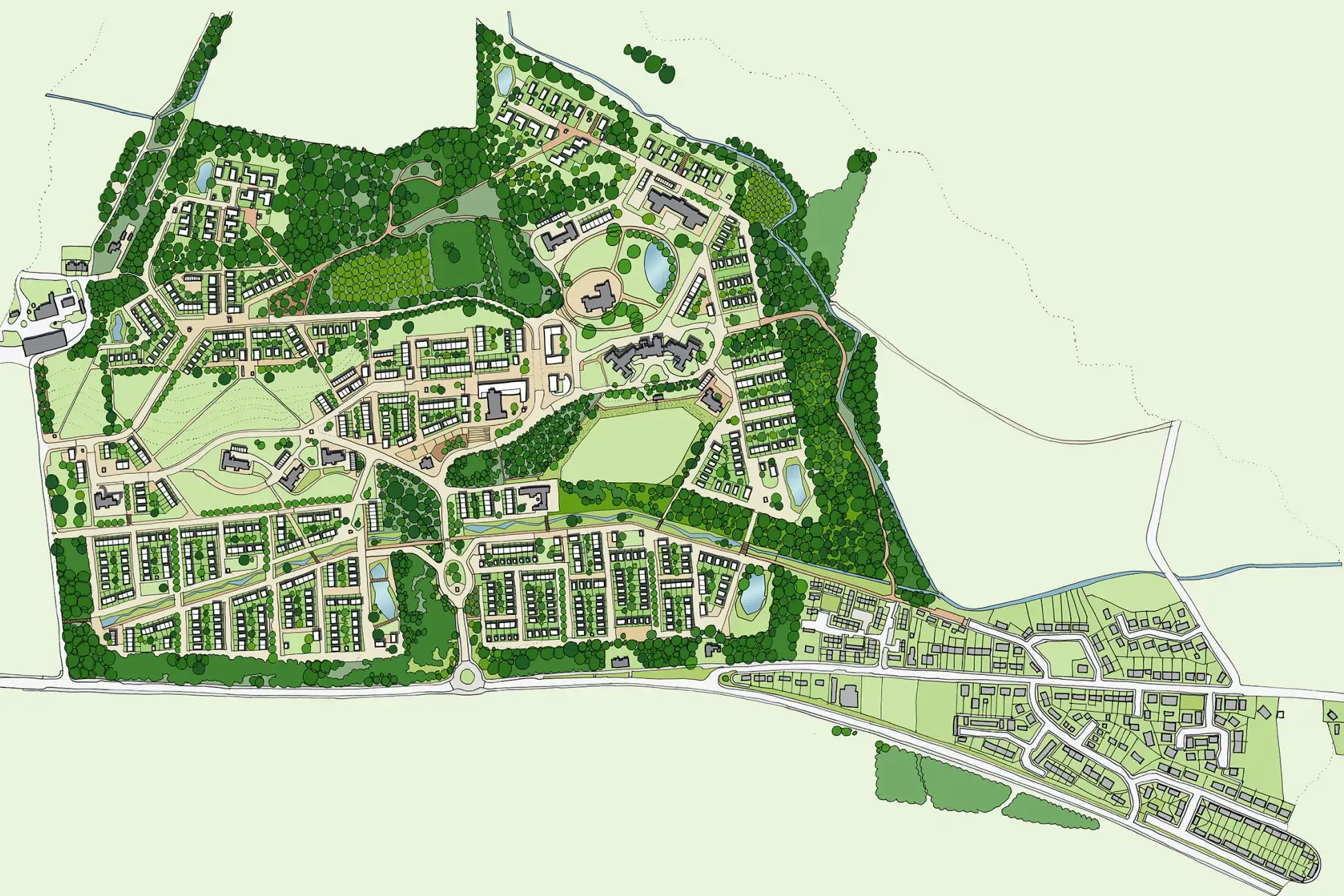
At Bangour Village in West Lothian, Scotland, Petrie Buchanan developed the utility strategy for a major mixed-use masterplan of up to 998 homes, including the district heating network that forms part of the development’s wider energy strategy, alongside off-site upgrades to major incoming utility connections.
When to involve us
Utility advice adds value on most projects with site-wide infrastructure. It’s particularly worth involving Petrie Buchanan early when:
- Your utility connections haven’t been designed yet, or you’re relying on a single quote from one provider.
- A connection quote seems high. Petrie Buchanan can benchmark it against the market and challenge it where it’s justified.
- You’re planning a multi-phase or masterplan-scale site, where capacity for future phases needs planning from the start.
- Existing pipes, cables or overhead lines cross the site and could conflict with the proposed layout.
- Cost certainty and programme are priorities, and you want to reduce procurement risk and avoid redesigns later.
- The project is sustainability-led, especially if it involves district heating, energy centres or all-electric design.
- You own or are developing a large site. The utility network you install can have asset value of its own when it’s adopted.

Bring this opportunity to your next project
Growing energy demand, electrification and the move to more sustainable buildings are putting more and more pressure on existing utility infrastructure. For developments of every type and scale, utility availability can now make or break feasibility, design and long-term performance.
Early coordination between utility and building services specialists has become essential. With Petrie Buchanan now part of the Wallace Whittle Group, we’re helping clients plan the infrastructure their developments need now and in the future.
To find out more about how we can support your next project, get in touch with Petrie Buchanan to arrange a conversation around your goals and requirements.