



The incoming Future Homes Standard is anticipated to fundamentally change how residential schemes are designed, costed and delivered, going beyond the requirements of the current Building Regulations.
From 2025, new homes are expected to produce around 75–80% fewer carbon emissions than homes built to the 2013 Part L Building Regulations baseline, largely attributed to utilising low-carbon heating as a default, an improvement in building fabric energy efficiency, and a new, more complex energy modelling methodology through the introduction of the Home Energy Model (HEM).
For developers and project teams, the Home Energy Model ensures that the assessment of building energy performance is no longer just a compliance exercise, as it will now require and consider a more in-depth look into:
- Heating strategies and plant space
- Electrical infrastructure and grid capacity
- Design coordination between architecture and MEP
- Programme sequencing and early-stage decision-making
- Capital cost and long-term asset performance
The direction of travel is clear, but the question is: Is your current project pipeline aligned with it.
Projects that treat the Future Homes Standard as a late-stage regulatory hurdle increase the risk of redesign, delay , and avoidable cost uplift. Those clients and developers seeking to incorporate the requirements early in the design can plan for greater compliance margins, an increase in project viability, and improved energy performance from the outset.

What is the Future Homes Standard?
The Future Homes Standard (FHS) is a set of mandatory regulations designed to significantly reduce carbon emissions from new homes in England. Its primary goal is ambitious, but by 2025, all new homes should emit 75–80% less carbon, and equivalent emissions than homes built under the current regulations. The standard represents a major step in the UK’s journey toward net-zero housing, supporting the decarbonisation of domestic energy use by utilising the rapidly increasing number of renewable energy systems coming online to the UK national electricity grid.
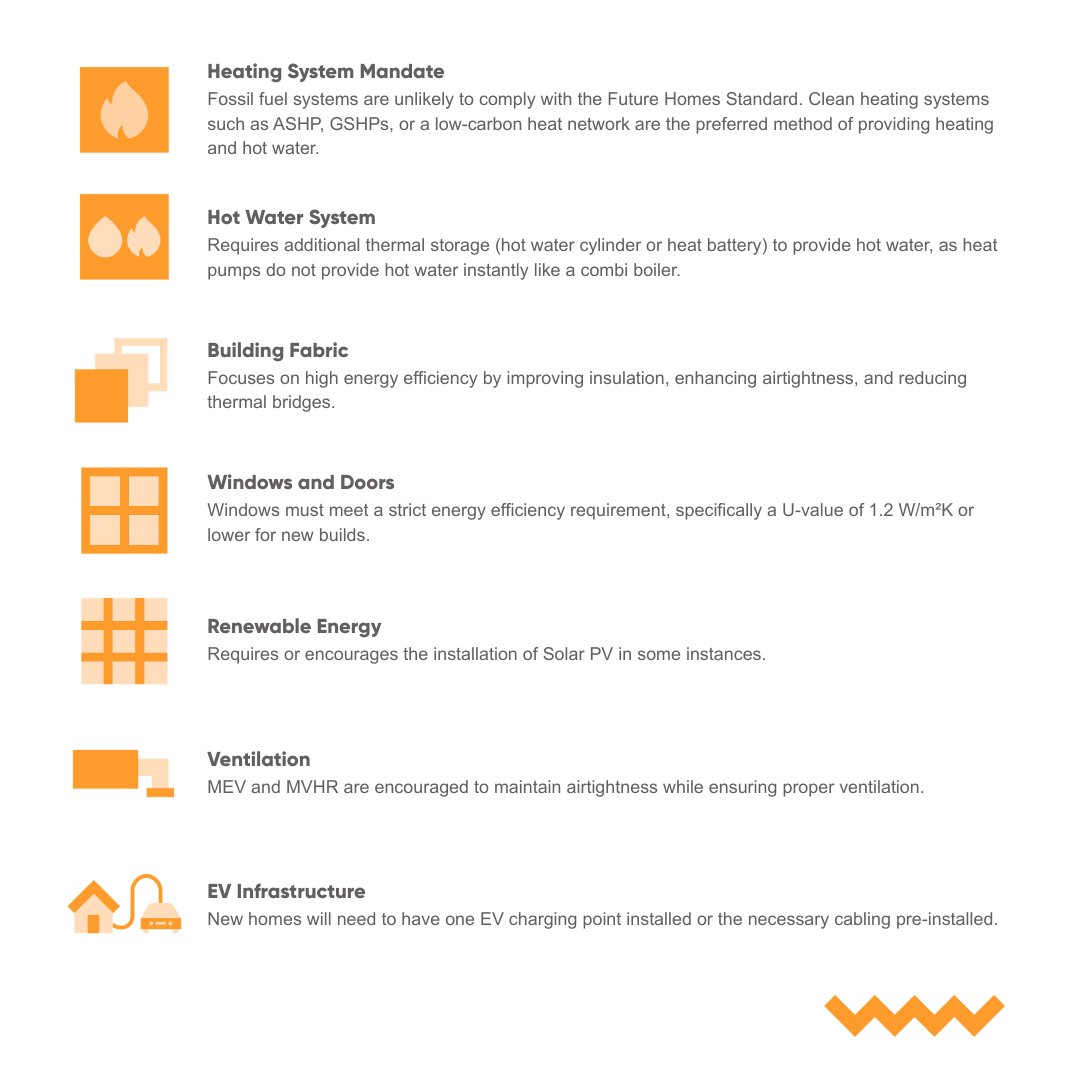
The FHS is part of a broader strategy to tackle climate change while maintaining practicality and affordability for developers and homeowners. It does this by mandating high-performance building fabric energy efficiency, installation of low-carbon heating systems, and increasing the requirement for provision of renewable energy. Unlike previous updates to Building Regulations, the FHS also introduces a new approach to compliance and modelling through the Home Energy Model (HEM), which allows for more detailed, dynamic, and realistic assessments of a building’s energy performance.
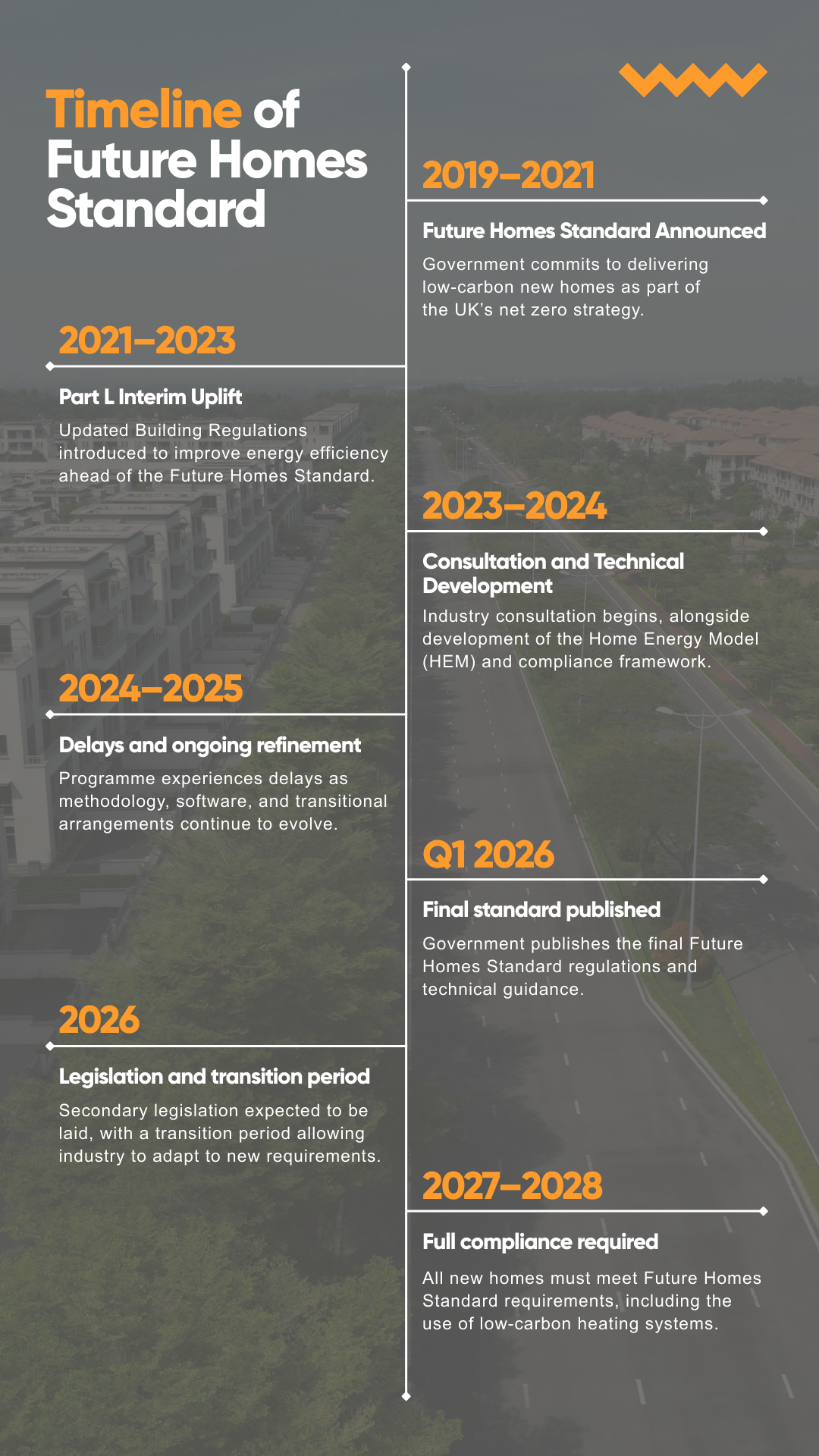
While the goals are clear, the rollout of FHS has not been without challenges. The programme has experienced delays with arrangements still being finalised, including ongoing questions around training, accreditation, and the impact on project costs and timelines.
What are the key changes?
For developers, designers, and consultants, the key changes go beyond compliance and will influence decisions much earlier in the project lifecycle.
Under the FHS, fossil fuel boilers will no longer be permitted in new homes. Instead, developments will be expected to adopt low-carbon heating solutions such as:
- Air source heat pumps (ASHPs)
- Ground source heat pumps (GSHPs)
- Connection to low-carbon district heat networks
This marks a major cultural and technical shift for the sector, requiring heating strategies to be considered from the very earliest design stages.
The FHS places greater emphasis on the “fabric first” approach, meaning:
- Improved insulation standards
- Enhanced airtightness targets
- Reduced thermal bridging
- Better-performing windows and doors
The intention is to reduce overall energy demand before relying on technology to offset performance.
With HEM requiring a greater number of inputs in more detail, project teams will need to:
- Confirm heating strategies earlier
- Lock in fabric performance sooner
- Coordinate MEP and architectural decisions more closely
Late-stage design changes are likely to become more costly and difficult to accommodate.
With HEM requiring a greater number of inputs in more detail, project teams will need to:
- Confirm heating strategies earlier
- Lock in fabric performance sooner
- Coordinate MEP and architectural decisions more closely
Late-stage design changes are likely to become more costly and difficult to accommodate.
With more sophisticated modelling comes an expectation of:
- Additional detailed technical submissions for a range of servicing equipment
- Greater scrutiny at compliance stage
- Increased coordination between disciplines
This will have implications for workloads across the design team, assessors, and building control.
Together, these changes are intended to drive better-performing homes that are lower-carbon, more resilient, and cheaper to run over their lifetime. However, they also demand a higher level of coordination, earlier engagement, and stronger technical understanding across project teams.
Modelling, Skills, and Workload
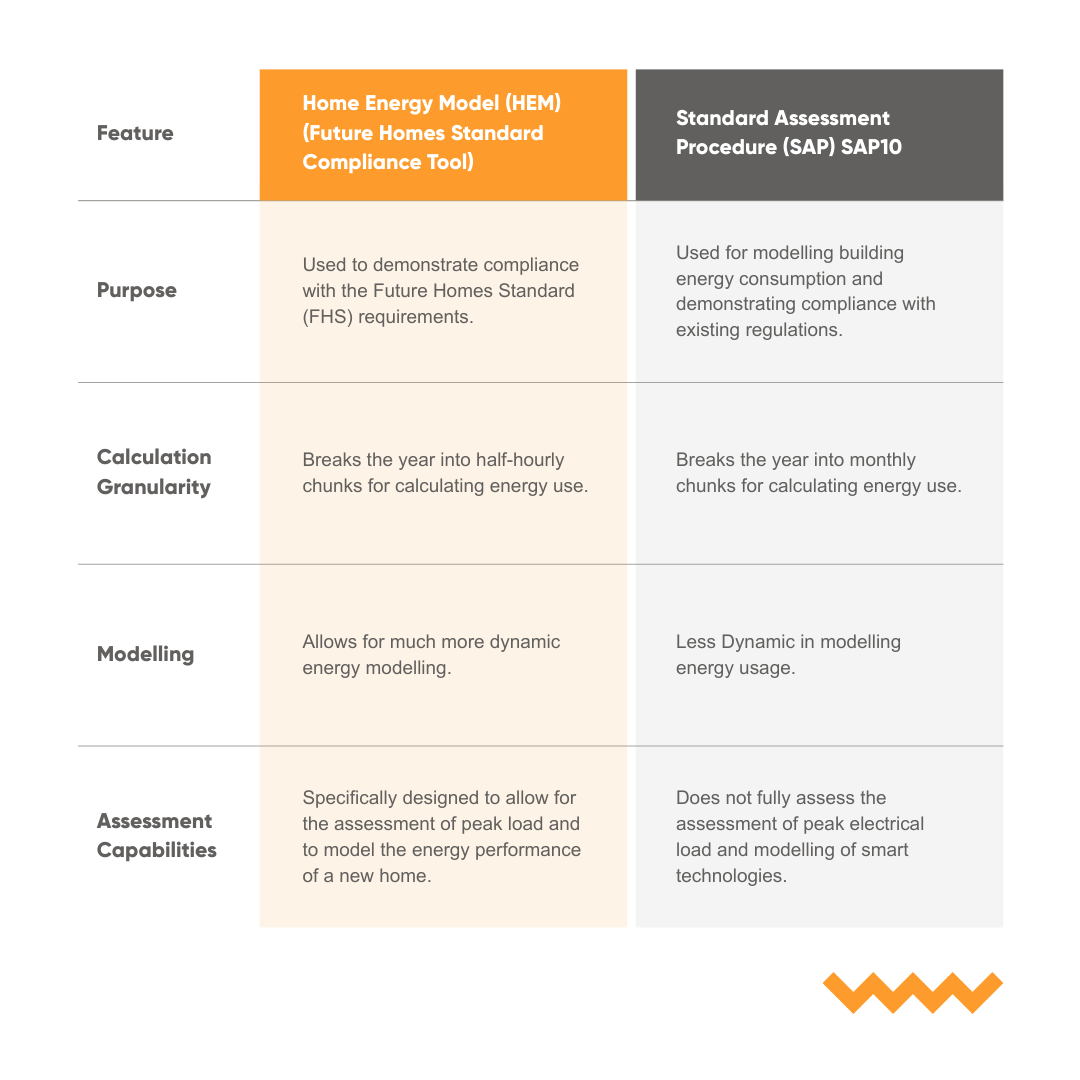
One of the most significant changes introduced by the Future Homes Standard is the transition away from the Standard Assessment Procedure (SAP) as the primary compliance tool. In its place, the Home Energy Model (HEM) will provide a more detailed approach to assessing energy performance.
While both tools aim to demonstrate regulatory compliance, the methodology, level of detail, and practical implications for design teams differ quite considerably. The table below outlines the key distinctions between SAP and HEM, and what they mean in practice.
Market Impact & Opportunities
As the industry prepares for the transition, many organisations are already reviewing design strategies, heating specifications and development programmes to understand how the Future Homes Standard may affect current and upcoming schemes. Craig Robertson, our Director for England shared with us:
“The Future Homes Standard brings a much-needed sense of direction and alignment across the residential sector in England. While the initial cost implications can feel daunting, many developers are already embracing the shift and recognising the long-term benefits of improved building performance and electrification.
At Wallace Whittle, we are fully engaging with initiatives such as the Future Homes Hub to stay ahead of the transition. Early decisions at client brief stage, particularly around heating strategy and energy performance, are now critical to managing cost and programme risk.
We also hope to see continued alignment between the Future Homes Standard and Section 6 requirements in Scotland, helping to create greater consistency across the UK market.”

Challenges, Uncertainty and the Journey Ahead
However, delays to publication, uncertainty around transitional arrangements, and concerns over software readiness have created some hesitation across the industry.
Developers may face a slight increase in upfront capital costs, tighter design coordination, and longer modelling processes. Design teams must commit to key decisions earlier in the project lifecycle, while assessors and local authorities prepare for higher workloads.
There are also broader questions surrounding affordability, viability, and embodied carbon regulation, which remains outside the scope of national Building Regulations for now. For some, it feels ambitious; for others, it is long overdue.
While some elements of the FHS are still to be finalised, the direction is sufficiently clear to begin meaningful early-stage assessments. With SAP 10.3 expected to be released alongside the FHS, and HEM to follow shortly after, there will be a defined transition period being SAP is fully retired, likely no earlier than Summer 2029.
What Developers Should Be Thinking About Now
The transition to the Future Homes Standard will require changes across the entire residential delivery process, from early design decisions through to construction and compliance assessment.
For developers and housing providers, one of the most important steps is ensuring design teams are prepared for the shift in how domestic energy performance will be modelled and assessed. The introduction of the Home Energy Model represents a significant change from the established SAP methodology, and the industry will need time to develop the necessary skills and processes.
Skills gaps and design team readiness are already emerging as potential challenges. Responding to regulatory change is never straightforward, and with the Future Homes Standard introducing new modelling approaches and performance expectations, many project teams will need to adapt their design strategies and technical understanding.
At the same time, uncertainty around final regulatory details and implementation timelines presents a further risk for developers progressing schemes in the near term. Clients may be working to specifications and cost assumptions based on current regulations, which may not fully align with the final Future Homes Standard requirements.
Early engagement and informed decision-making will therefore be critical. Considering energy strategy, heating systems and building performance at the earliest stages of project development can help reduce the risk of late design changes or additional costs as the new standards are implemented.

Wallace Whittle works with developers, housing providers and contractors to help navigate the transition to new regulations and standards.
Our sustainability specialists are actively engaged in residential low-carbon design and assessment, working closely with accreditation partners and industry bodies to monitor developments around the Future Homes Standard. This allows us to provide clients with early insight into likely requirements and the potential impact on design, specification and programme.
Through early-stage energy strategy, compliance modelling and heating strategy optioneering, we help clients understand both the risks and opportunities associated with the transition. Our focus is on ensuring that development plans remain viable, while aligning projects with the evolving regulatory landscape.
With a long track record in the residential sector and strong industry partnerships, we are well positioned to support developers in managing this transition and preparing schemes for the Future Homes Standard.
Our specialists are supporting clients in navigating the transition to low-carbon compliance. From early-stage feasibility through to detailed modelling and delivery, we can help ensure your project is ready for what’s ahead. Get it touch with our team at [email protected]
Elmhurst Energy. (2025). Future Homes Standard 2025 Round-Up: SAP, HEM and What’s Coming Next – Elmhurst Energy. [online] Available at: https://www.elmhurstenergy.co.uk/blog/2025/12/10/future-homes-standard-2025-round-up-sap-hem-and-whats-coming-next/.
Jones, V. (2022). Changes to Approved Document L and the Future Homes and Buildings Standard – Structural Timber Association. [online] Structural Timber Association. Available at: https://www.structuraltimber.co.uk/news/changes-to-approved-document-part-l-and-the-future-homes-and-buildings-standard [Accessed 6 Mar. 2026].
Kensa. (2025). Future Homes Standard & Building Regulations & Changes 2025 | Kensa. [online] Available at: https://kensa.co.uk/housing-developments/future-homes-standard.
Norrsken Company Ltd. (2025). The Future Homes Standard 2025 explained. [online] Available at: https://www.norrsken.co.uk/blogs/regulations/the-future-homes-standard-2025-explained.
Sunamp Global. (2024). Future Homes Standard 2025: How low carbon technologies will transform the built environment. [online] Available at: https://sunamp.com/blog/future-homes-standard/.